
How to use this template
Give the plan 1 owner and fill it in from top to bottom. The order matters: you cannot size parking until you know how many people will come by transit, shuttle or carpool, and you cannot pick shuttle routes until you know where attendees live. For a large event, start about 8 weeks before the doors open.
Press Copy template to paste it into a document, or Print for a clean paper copy. Lines that end with a colon are for your answers.
The template
Event transportation plan template
1. Event basics
- Event name, dates and venue address:
- Gates or entrances attendees use, and the gate for each mode:
- Doors open, last act and close, for each day:
- Expected attendance, for each day:
- Transport lead (name and day-of phone):
2. Where attendees come from
Source: ZIP code at checkout, last year’s ticket data, or 1 question in the confirmation email ("Where are you coming from, and how do you plan to get here?").
| Origin area | Share of attendees | Distance or drive time | Transit at your end time? |
|---|---|---|---|
3. Modes and capacity
For each mode: the share you expect, how many people it can actually carry at peak, and the gap.
| Mode | Expected share | Capacity at peak | Gap and fix |
|---|---|---|---|
| Walk or bike | |||
| Public transit | |||
| Shuttle | |||
| Carpool (3 or more people per car) | |||
| Ride-hail or taxi | |||
| Own car, 1 or 2 people | |||
| Accessible transport |
4. Parking and passes
- Spaces on site, and overflow lots with their walking distance:
- Lot opening and closing times:
- Prepaid or free passes, and how they are checked at the entrance:
- Carpool incentive (for example, the closest lot for cars with 3 or more people):
- Staff per lot, and the signal that a lot is full:
- Plan for the exit: lanes, order of release, time to clear:
5. Shuttle decision
A route earns a bus only when enough people leave from 1 pickup point at the same time. Fill in each candidate route.
| Pickup point | Riders expected (from survey) | Vehicle and seats | Times there | Times home | Quote and cost per seat |
|---|---|---|---|---|---|
6. Carpool and ride-share plan
- Where the carpool link or sign-up goes (ticket email, FAQ, event site, social posts):
- Driver ask: date it goes out, and that it asks for both directions:
- Deadline for posting rides home:
- Incentive for full cars, if any:
- Privacy rule: no phone numbers or home addresses on a public list:
- Who answers attendee questions about rides:
7. Drop-off and pickup zones
- Ride-hail and taxi zone (location, signs, the pin you publish):
- Carpool drop-off point:
- Shuttle bays and the queue layout:
- Walking route from each zone to the gate (lighting, surface, distance):
- Staff at each zone at the end of the night:
8. Accessibility
- Accessible parking: number of spaces and where they are:
- Accessible shuttle vehicles (lift or ramp) and how to book a seat:
- Drop-off closest to the gate, kept clear for people who need it:
- Step-free route from every drop-off point:
- How attendees ask for help before the event, and on the day:
9. Late-night return
- Last transit departure from the nearest station:
- Last shuttle time, printed on the ticket and announced from the stage:
- Ride-hail plan at close (zone, staff, expected wait):
- Rides home posted before doors open (where, and who sends the ask):
- A lit, staffed waiting area:
- Plan for attendees who should not drive:
10. Communications timeline
| When | What to send | Channel |
|---|---|---|
| 8 weeks before | The "where are you coming from, and how" question; book shuttles and lots | Ticket confirmation email |
| 4 weeks before | Transport page: transit, shuttle times, parking, drop-off zones, the carpool link | Event site, FAQ |
| 3 weeks before | Driver ask: post your free seats, there and back | Email to ticket holders, social |
| 1 week before | Reminder: last shuttle time, parking passes, carpool link | Email, SMS if you have consent |
| 2 days before | Final: maps, gate for each mode, ride-hail pin | Email, app or social |
| Day of | Signs at lots and exits; stage announcement 1 hour before the last shuttle | Signs, stage, social |
| Day after | Thank you, and 1 question: how did you get here and home? |
11. Day-of roles
| Role | Name | Phone |
|---|---|---|
| Transport lead | ||
| Parking lead | ||
| Shuttle dispatcher | ||
| Drop-off zone marshal | ||
| Accessibility contact | ||
| Attendee messages (social, email) | ||
| Shuttle company dispatch | ||
| Towing and local police non-emergency line |
12. What to measure after
- Cars parked at peak, and people per car (count a sample at the entrance):
- Shuttle riders per departure, there and home:
- Time to clear the lots after close:
- Carpool numbers: rides offered, people who found a ride:
- Complaints and questions about getting there or home:
- Areas with many people and no good option, for next year:
How to fill in the sections that matter most
Where attendees come from
Everything else depends on this section. Add a ZIP code field at checkout if your ticketing allows it, use last year’s ticket data, or ask 1 question in the confirmation email: “Where are you coming from, and how do you plan to get here?” Group the answers into areas and sort them by size. An area with many people and no transit at your end time is where the plan has to work hardest.
Modes and capacity
For each mode, write the share of attendees you expect and how many people that mode can actually carry in your arrival and departure windows. A train that runs every 30 minutes, a lot with 800 spaces and 4 shuttle buses each have a ceiling. The gap column is where the plan earns its keep: if more people will drive than you have spaces for, you need fuller cars, more shuttles or more overflow parking.
The shuttle decision
A shuttle costs about the same whether it is full or half empty, so it pays off where many people leave from 1 pickup point at 1 time. Get quotes per route and divide by the riders you really expect, from a survey, not from venue capacity. Our event transportation playbook shows the full method, with a rule of thumb for when a route earns a bus.
Carpool and ride-share plan
Most plans write “encourage carpooling” and stop there. Write down instead where the carpool link goes, when the driver ask goes out, and the deadline for rides home. Riders follow free seats, so drivers come first. Keep phone numbers and home addresses off any public list: ask for an area, such as a neighborhood or a town, and let people share contact details once they agree to ride together. For a small event, a carpool sign-up sheet does the job.
The late-night return
Arrivals spread over 1 or 2 hours. Departures do not: some people leave after the headliner, some at close, and the last train or shuttle sets a hard edge. Print the last shuttle time on the ticket, announce it from the stage 1 hour before, and make sure rides home are posted before the doors open. During the event, almost nobody stops to post a ride.
A worked example for a festival of 4,000 people
The numbers below are assumptions to show how the sections fit together. Replace them with yours.
| Section | Example entry |
|---|---|
| Event basics | 4,000 people, 1 day, gates 2 PM, close 11 PM, a park 25 miles from the nearest city |
| Where attendees come from | 55% from the nearest city, 25% from 3 suburbs, 20% from more than 1 hour away |
| Modes and capacity | No transit after 9 PM; 1,200 parking spaces on site and 400 in an overflow lot 10 minutes’ walk away |
| Shuttle decision | 1 route from the city’s main station: 5 buses, there from 1 PM, home at 9:30 PM and 11:15 PM |
| Carpool plan | Link in the ticket email; driver ask 3 weeks out, for both directions; rides home posted by the day before |
| Parking and passes | Prepaid passes; cars with 3 or more people park in the closest lot |
| Drop-off zones | Ride-hail zone at the north lot, signed from the road, with 2 staff from 10 PM |
| Late-night return | Last shuttle announced from the stage at 10:15 PM; a lit waiting area at the ride-hail zone |
| What to measure | Cars at peak, people per car from a sample of 200 cars, shuttle riders per departure, time to clear the lots |
The check that matters: 1,600 spaces for the people who drive. If 2,800 people come by car at 2 people per car, that is 1,400 cars, which fits with little room to spare. At 1.7 people per car it is about 1,650 cars, and the lots overflow. Fuller cars are the cheapest margin in the plan.
Where a ride board fits in the plan
A shuttle serves people near its pickup points at its times. A ride board covers the rest: people spread across many towns, and anyone who leaves at a different time from the bus.
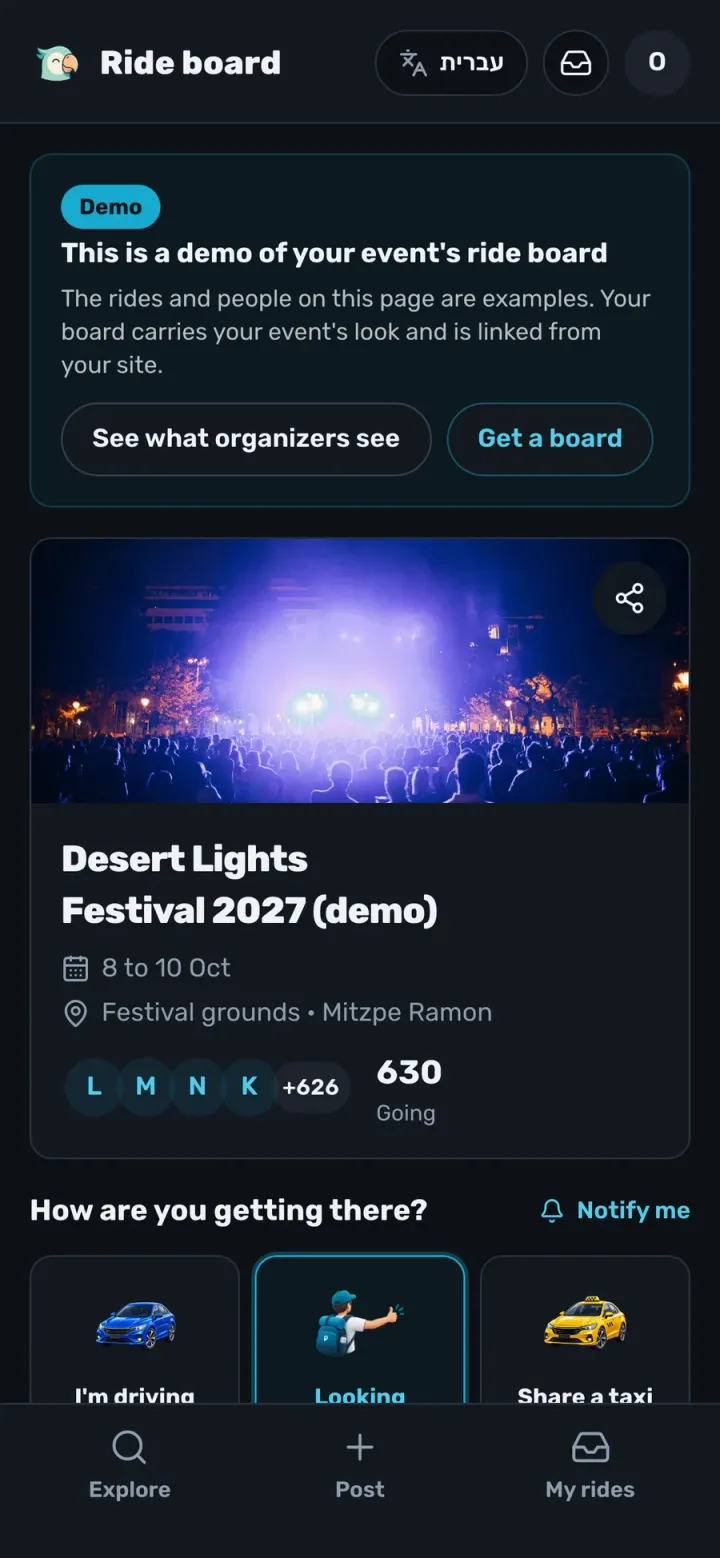
With PairMee, the organizer shares 1 link, in the ticket email, the FAQ or the transport page. Drivers going to the event post their free seats, there and back. People without a car ask to join a ride from their area, and the driver approves each request. There is nothing to integrate with your ticketing. The organizer dashboard shows totals by area and by day, never names, so you can see where people are still looking for a ride while there is time to send a driver ask or add a bus.
At a 3-day festival in October 2026, 68 people joined the board and 31 people were matched with a ride. A board does not create drivers, and it cannot promise every rider a seat: it works when drivers are asked early and answer requests quickly.
Your first event is free, then boards start from $299 per event. See how it works for events or our prices.