

Start from where your attendees live
Start 1 step before the venue, with a map of where people are coming from and when they will want to leave. Take it from ticket data (city or postcode at checkout), from last year’s event, or from 1 question in your confirmation email: “Where are you coming from, and how do you plan to get here?”
Then sort every origin into 1 of 3 groups:
- Transit works both ways. A train or bus runs at the hours you need, there and back. Promote it and stop there. When Tel Aviv hosted about 45,000 marathon runners in February 2026, runners were asked to come on foot or by train (Maariv, ynet).
- A cluster big enough for a bus. Many people from 1 area who can leave at the same time.
- Everyone else. People spread across dozens of towns, and anyone who wants to leave at a different time from the bus. It is often the biggest group, and the one most plans leave to luck.
When a shuttle pays off: the decision rule
A shuttle costs the same per vehicle whether it is full or not, so the cost per seat depends on how many people get on. Busly, an Israeli bus quote marketplace, publishes a price index from real quotes. As of 11 October 2026, a bus for 21 to 55 people had a median price of ₪2,400 per trip, in a range of 1,400 to ₪3,800, from 430 quotes by 54 companies, including VAT, driver and fuel. A minibus for 11 to 20 people had a median of ₪1,960 (800 to 3,000). A full day out and back, 9 hours or more with waiting, had a median of ₪3,200 (1,700 to 6,400, from 31 quotes).
| People on the bus | Cost per seat at the ₪2,400 median |
|---|---|
| 55 | ₪44 |
| 45 | ₪53 |
| 35 | ₪69 |
| 25 | ₪96 |
| 15 | ₪160 |
Our rule of thumb:
- 35 or more people from 1 pickup point, leaving at the same time: book a bus.
- 15 to 35: a minibus or a midibus, or merge 2 nearby pickup points into 1.
- Fewer than 15 from an area, or people who will leave at different times: shared rides between attendees.
How many vehicles. Divide the expected riders from each pickup point by 50 and round up. Planning for 50 on a 55-seat bus leaves room for late sign-ups. Expected riders means people from that area who say they will take a shuttle, not a share of your venue capacity. If you have no data, ask before you book.
Pickup points. Pick places people can reach and leave a car at, such as a train station with parking or a large car park at the edge of a city. Use 1 point per cluster, not 1 per neighbourhood: every extra stop adds time for everyone already on the bus.
The way home is where plans break
Everyone wants to arrive at roughly the same time. Going home is the opposite: some people leave after the headliner, some at closing, some the next morning.
The last bus at 02:00
Each bus has 1 departure time. One Israeli operator’s published price list includes a return until 02:00 and charges ₪150 for each extra hour of a bus (busrental.co.il). Busly names waiting time as the biggest single driver of a quote. So you choose: hold the buses until the end and pay for the wait, or split the return into 2 waves (for example 23:30 and 01:30) and size each wave from your survey. Either way, everyone who leaves outside those times needs a seat in a car. Print the last shuttle time on the ticket, and get the rides home on the board before the event.
Multi-day festivals
Arrivals spread over the first day. Departures bunch on the last day or the morning after. Some festivals sell shuttle tickets as a round trip with 1 fixed return time, which does not fit people who leave a day early. Plan the way back per day. On a PairMee board, drivers pick the festival day in 1 tap, and rides to the event and rides back sit in separate lanes.
Remote venues
Where no train or bus reaches the gate, the only options besides your shuttle are private cars. Every car that arrives with empty seats is capacity you already have and are not using. The hardest ride at a remote site is the one home, when people leave over several hours.
Races that start at dawn
Road races start early and close roads before the start. The Dead Sea Marathon asks runners to be at Ein Bokek about 2 hours before their start (race schedule, January 2026). For runners from the center or the north, that means driving in the middle of the night, from dozens of towns, with no transit at that hour. A shuttle cannot serve every town at 03:00. Runners from the same area driving together can. And when an organizer reserves car parks for participants, as the Jerusalem Marathon did in April 2026, 3 runners per car make those spaces go 3 times as far.
Conferences and parking pressure
At a conference, parking is often the hard limit. Expo Tel Aviv lists about 2,500 spaces on its grounds plus about 2,000 in Ganei Yehoshua, and transport works are taking hundreds of the Ganei Yehoshua spaces for about 2 years (tlvonline, December 2025). Attendees who share the drive need fewer of them. More on this for conferences.
City events
Cities face the same problem with their own events: a festival in the park, a holiday night, a concert in the square, with residents coming from every neighborhood and parking that cannot grow. See how the same board works for cities and councils.
A worked example: 3,000 people, 60 km from the nearest city
The numbers below are assumptions to show the method. Replace them with yours.
- An evening event: doors at 19:00, ends at 01:00. No train or bus to the venue at night.
- Ticket data: 1,500 people from the nearest city and its suburbs, 900 from a large city 120 km away, 600 from about 50 smaller towns.
- 20% of people in the 2 cities say they would take a shuttle.
Step 1: shuttles. The nearest city gives 1,500 × 20% = 300 riders. Split them across 2 pickup points of about 150, which is 3 buses each: 6 buses. The far city gives 180 riders from 1 pickup point: 4 buses of 45. That is 10 buses for 480 people. None of the 50 small towns reaches 35 riders, so they get no bus.
Step 2: cost. At Busly’s ₪3,200 median for a day out and back with waiting, 10 buses come to about ₪32,000, or about ₪67 per rider for both ways. The far route will likely quote above the median, so get 3 quotes per route. If you sell shuttle seats instead of giving them, a price near ₪70 covers the median.
Step 3: the return. Say a third of riders tell you they will leave around midnight. Send 3 buses at 00:00 and 7 at 01:15. Anyone leaving at 22:00 needs a car.
Step 4: cars and parking. 2,520 people still come by car. At 2 people per car that is 1,260 cars. If the ride board lifts the average to 2.5, it is about 1,010 cars: 250 fewer spaces to find, and 250 fewer cars on the access road at 01:00. Without shuttles or a board, the same crowd at 2 per car would be 1,500 cars.
Step 5: who is still uncovered. The 600 people from small towns, everyone leaving before the shuttle times, and anyone who misses a bus. That is the job of the ride board.
The planning timeline
8 weeks before
- Map where attendees come from, and add the “where from, and how” question to your confirmation email.
- Decide which clusters get a shuttle and ask for 3 quotes per route. Busly’s median booking is 14 days ahead, but busy dates fill earlier.
- Decide whether shuttles are free or sold.
- Send us your poster and details. We build the event page, live within 1 day.
4 weeks before
- Publish pickup points and times, including the last return.
- Open the ride board: a button on your site, a line in your FAQ, the link in the ticket confirmation, a QR code on your posts.
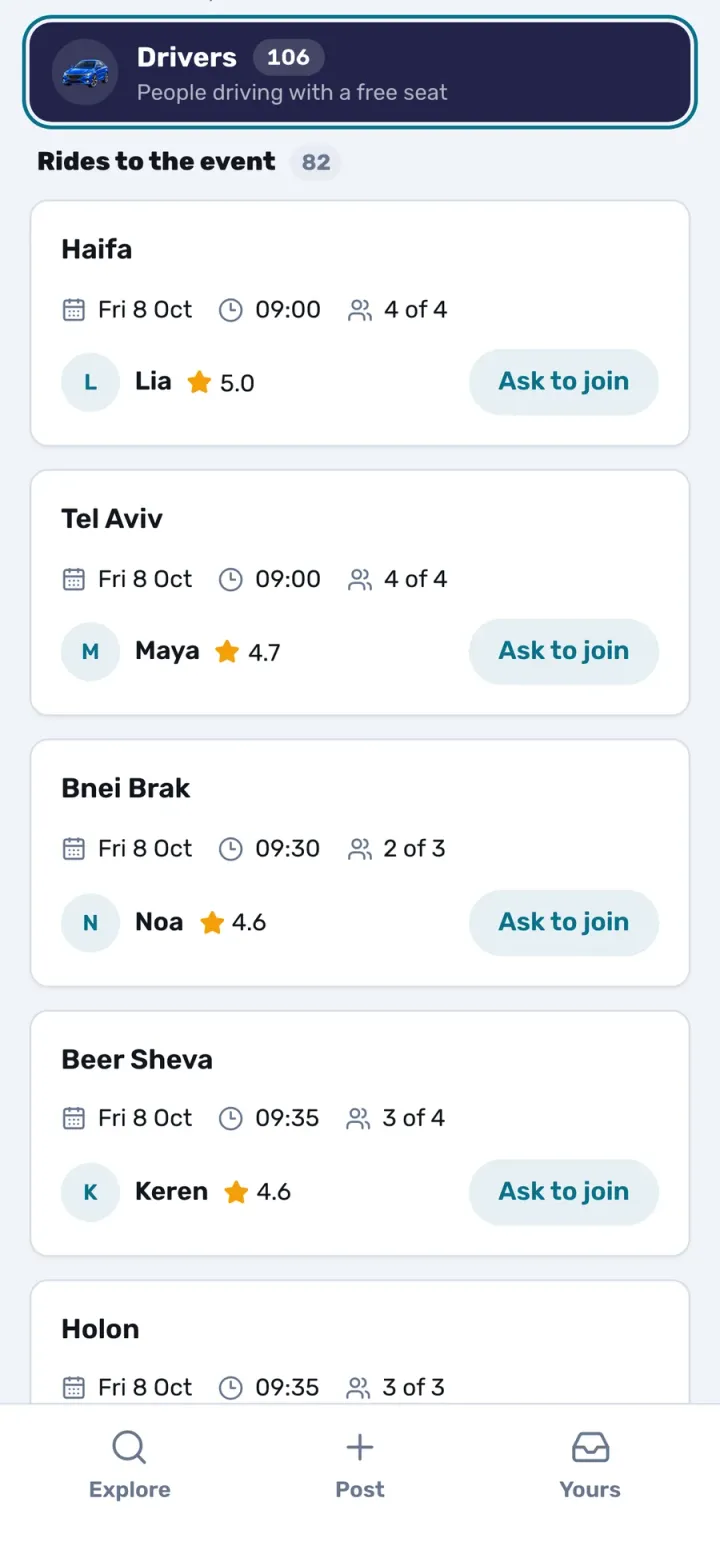
- Ask drivers first: “Driving? Post your free seats, there and back.”
1 week before
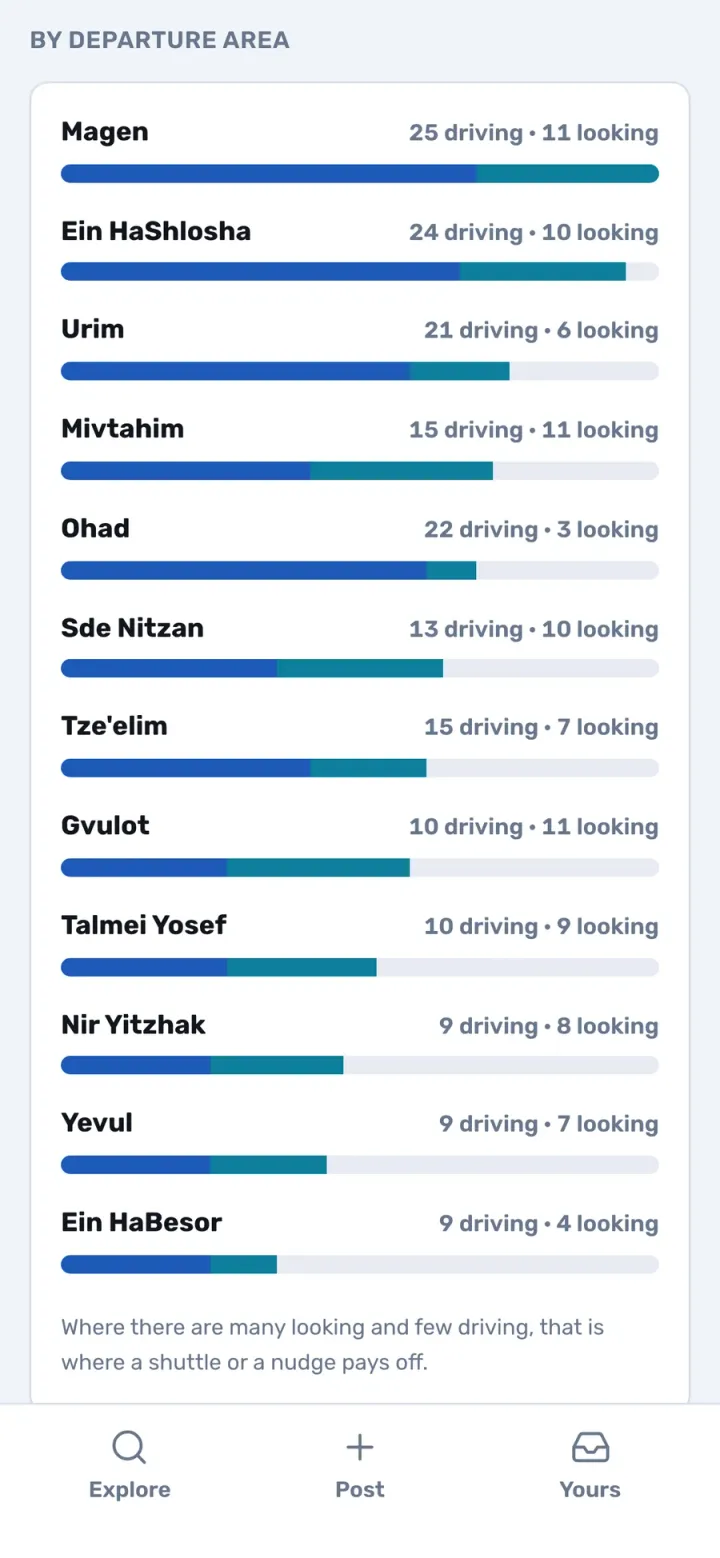
- Check the dashboard by departure area. An area with many people looking and few rides needs a direct driver ask, or a minibus.
- Check the rides back. If there are few, ask drivers to post them now.
- Send ticket holders a reminder with the last shuttle time and the board link.
- Give final rider counts to the bus operators.
On the day
- QR signs at the entrance, in the car park and at the exits.
- Announce the last shuttle time from the stage an hour before it leaves.
- We watch the board and answer people on WhatsApp and email, in Hebrew and English.
The day after
- Write down the numbers while they are fresh: riders per bus departure, cars in the car park at peak, time to clear it, and the dashboard totals.
- Read our written report.
- Note which areas should get a bus next year.
How to get drivers to post
Riders follow drivers, not the other way around. These are the numbers from KAN Festival, 3 days in the Judean Desert, which added a PairMee ride board.

From a live event, October 2026
KAN Festival in the Judean Desert, with a PairMee ride board
The organizers sent a banner and their ticket link. We built the event page; they added a button to their website and a line to their FAQ. Nothing else was asked of them.
The full numbers and what we learned22
matches made through the board
Between 31 people: 18 without a car and 13 drivers
19
people in 9 cars, to the day of the ride
Kept their match until the day itself
68
people joined the board
Posted a ride or listed themselves as looking
619
people opened the link
350 of them straight from KAN's website
A match: a person without a car found a driver from their area, and the driver approved them. Figures from our production data, test accounts excluded.
What we learned there:
- Ask drivers early, and ask them directly. Rides posted weeks ahead give riders time to find them and ask to join. A full car can earn a reason too: parking at the gate or a faster way in.
- Rides home go on the board before doors open. KAN ended on a Saturday, when no train runs home. Ask for both directions in the same message.
- Fast answers matter more than more requests. Once drivers could approve or decline from buttons inside the email they receive, the average answer time fell from 47.5 hours to 18.7 hours.
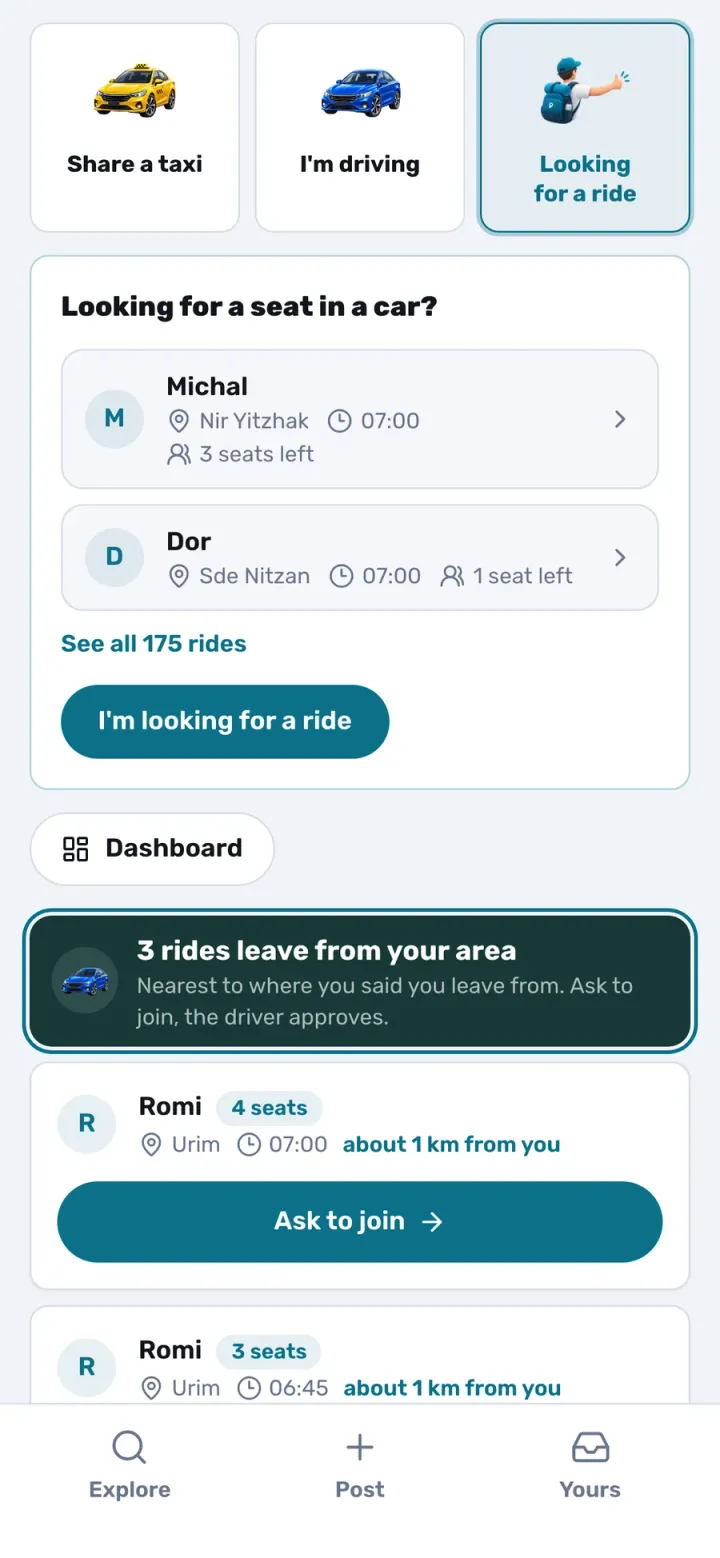
- Let riders be visible. People who list themselves as looking stay visible to drivers from their area, and can ask to be told when people from their area post a ride.
What to measure and report
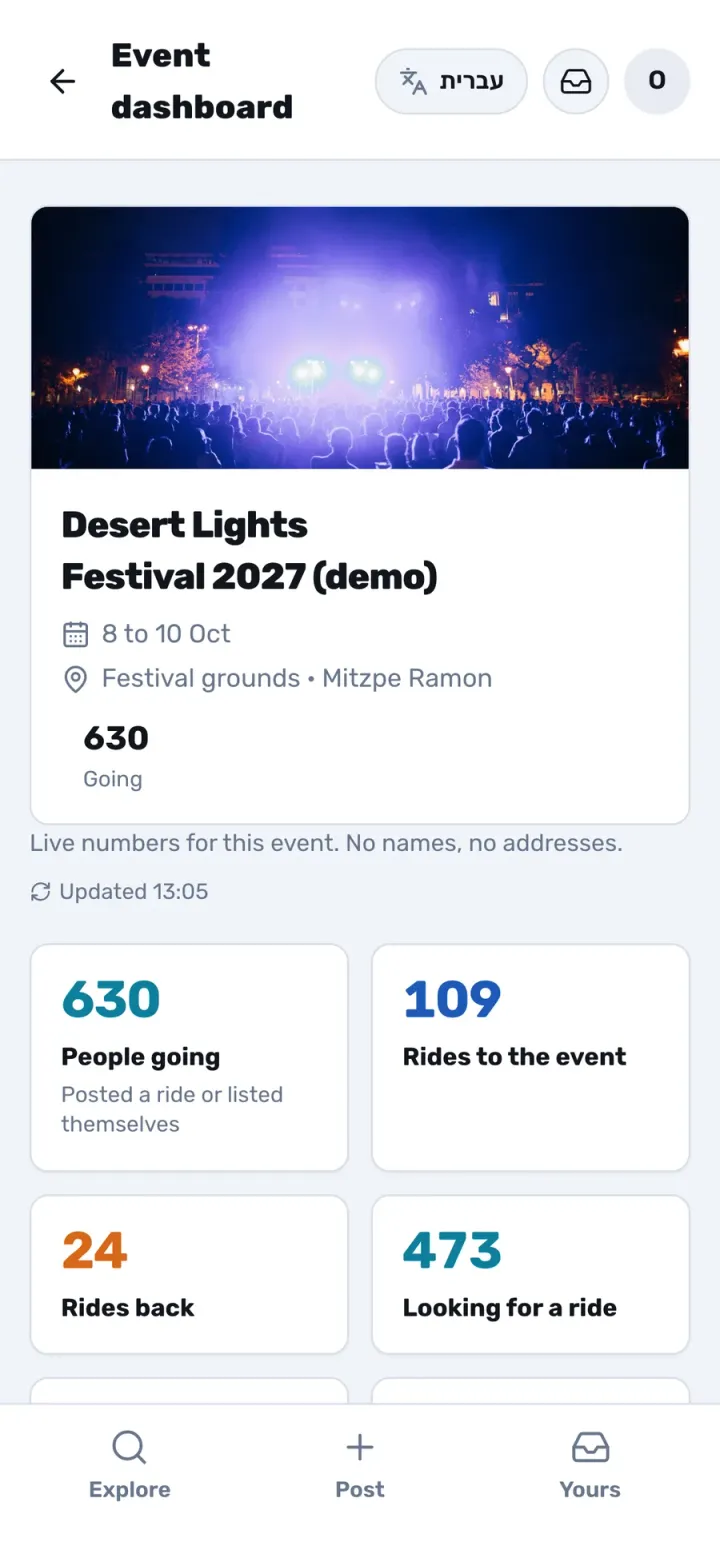
The organizer dashboard sits at the event’s own address, at /dashboard. It shows aggregate numbers only, with no names, and refreshes every minute:
- people going, rides to and from the event, people looking
- invites, join requests, groups formed, people matched
- by departure area: rides and people looking
- by day: rides in each direction
Read it for decisions, not applause. A departure area with many people looking and few rides is where next year’s bus goes. A low number of rides back a week before is the warning to send the driver ask again.
Emissions, if you report them. Count only the people who would otherwise have driven their own car. Multiply by their distance there and back, and use about 0.15 kg of CO2 per car kilometre avoided, the figure the Israeli environmental group Shomrei HaTeva uses for an average private car. For example, 40 people who leave their cars at home, 25 km each way, avoid 2,000 car kilometres, about 300 kg of CO2. Publish it as an estimate, with the method beside it.
Do you need a tool, or will a WhatsApp group do?
For a small group of people who know each other, a WhatsApp group or a shared sheet is enough. Use it. It stops working with hundreds of strangers.
| PairMee ride board | Shuttle buses | WhatsApp group or form | |
|---|---|---|---|
| Best for | Crowds spread across many towns | Big clusters leaving together | Small groups who know each other |
| Departure times | Each driver sets their own | 1 per bus | Whatever is posted |
| The way home | A separate lane for rides back | Fixed return times | Usually forgotten |
| Phone numbers | Never shown | Collected by you | Every member sees all of them |
| Staff time | Our team sets it up and watches it | Booking and lists | Needs a moderator |
| Numbers for you | Live dashboard and a written report | Bus counts | None |
In Israel there is 1 more reason. A form that collects names, phone numbers and travel times creates data protection duties for whoever collects it, and amendment 13 to the Privacy Protection Law has been in force since 14 August 2025.
What PairMee is, and what it is not
PairMee is not a transport company. We supply no vehicles and no drivers, and we do not replace your buses. People who already drive to your event offer their free seats, people who need a ride ask to join, and the driver approves every request. Then the group gets a chat in the app with a meeting point. Phone numbers are never shown, and pickup is shown as the area, never an exact address. Riders use it free, and any cost sharing is settled between the people in the car.
Our team builds the page, sends you the link, a QR code and print files for signs, answers your attendees, and sends a written report after the event. Read how an event partnership works, or the full desert festival case study.
It is not the right tool if everyone arrives by bus from 1 point, or if your group is small enough for 1 chat. We also cannot promise a seat to every rider: matches depend on drivers posting and answering, which is why the driver ask comes first.