

A one-time trip is not a school run
Most carpool guides online are about school runs: the same 6 families, the same route, every weekday. A one-time trip to a wedding, a festival, a reunion or a city event is a different problem:
- People do not know each other. You cannot just ask “who lives near Dana?”
- There are 2 trips, not 1. People arrive together but leave at different times, and the ride home is the one that breaks.
- Seats have to be counted. A car with 3 free seats and 5 people who think they are in it is a bad night for everyone.
- Plans change. Drivers cancel, riders find another seat and forget to say so.
- A guest is waiting at 01:00. If nobody planned the way back, that guest calls the organizer.
There are 6 honest ways to handle it. Each one is right for some groups.
The 6 options
- A WhatsApp group. Everyone joins 1 chat and posts “driving from X” or “looking from Y”.
- A Google Form and a spreadsheet. People sign up through a form, and 1 person matches rows in a sheet.
- A staff member coordinating by hand. A person on the team owns the list, the calls and the changes.
- A shuttle bus. You hire a bus from 1 or 2 pickup points, with 1 time each way.
- Building your own tool. A developer builds a sign-up and matching app for you.
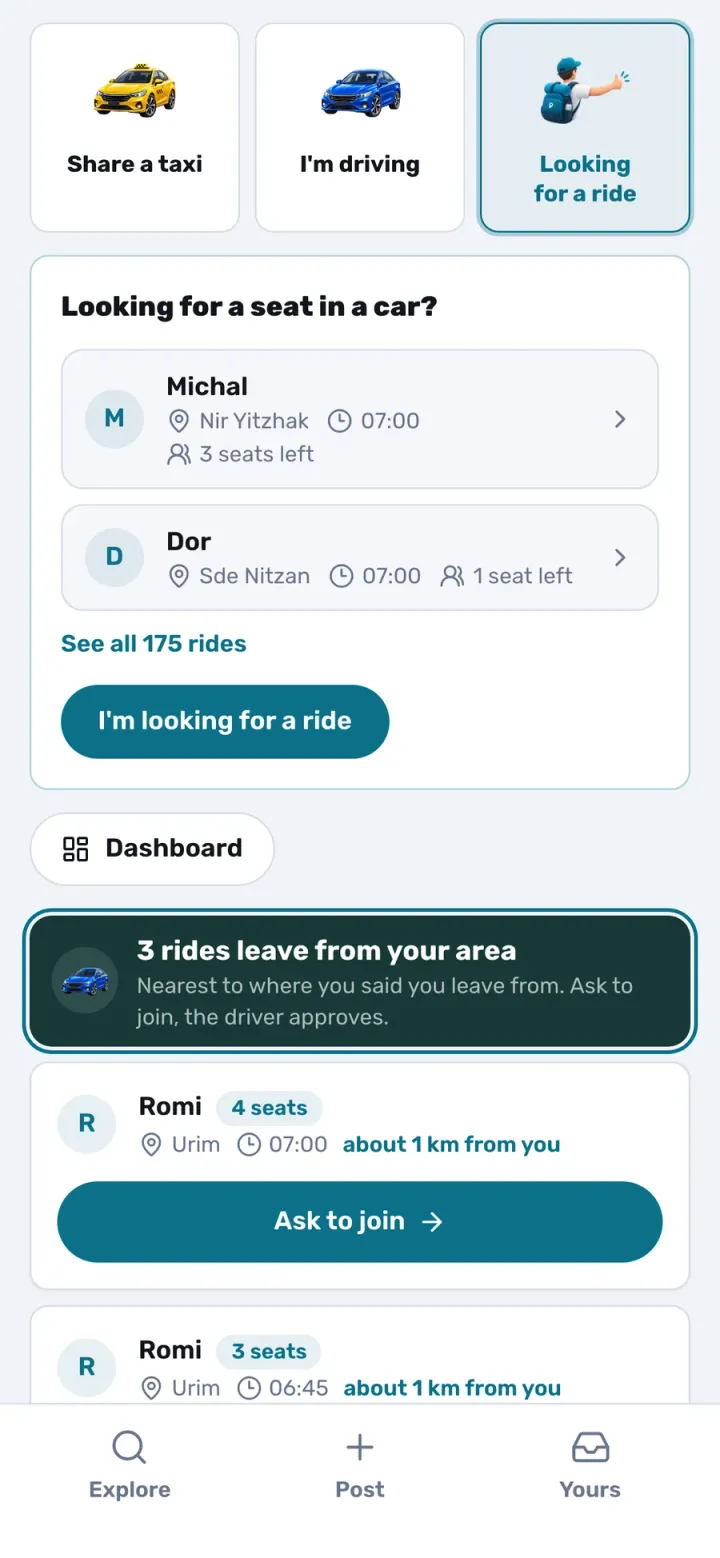
- A ride board like PairMee. A page for your event where drivers post free seats, people looking for a ride ask to join, and each driver approves who joins.
How they compare
The first 3 cost nothing but time. The comparison below is about where that time goes.
| PairMee | WhatsApp group | Form and spreadsheet | A staff member | |
|---|---|---|---|---|
| Setup effort | We build your event page within 1 day | 5 minutes | A few hours to build the form and sheet | Assign a person and a phone |
| Ongoing admin | None required from you; we watch the board | Answering the same questions again and again | The sheet needs updating every day | Their main job for the weeks before |
| Matching | People see rides from their area and time and ask to join | People scroll and hope | By hand, row by row | By hand, by phone |
| Onboarding | A link that opens in the browser; sign in with Google or an email code | Everyone already has it | A link, no account | A phone call per person |
| Notifications | Drivers get an email for each request; people looking can be told when a ride from their area is posted | Every message goes to every member | None | Whatever the coordinator remembers to send |
| Privacy | Phone numbers are never shown; pickup is by area, never an exact address | Members see each other's phone numbers | Names, phones and times in a shared file | Contacts on a work or personal phone |
| Moderation | Drivers approve every request; ratings, blocking, reporting, women-only rides | Admins remove people by hand | None | The coordinator's judgement |
| The way home | Rides back are their own lane, posted before the event | Late night messages that scroll away | Rarely planned | The coordinator is on call at 01:00 |
| Numbers for you | A live dashboard: people going, rides each way, people looking, join requests, people matched, no names | None | What people typed in | What the coordinator remembers |
| Maintenance | Ours | None | Rebuilt for every event | Trained again for every event |
| Cost | Free for people sharing rides; organizations pay a fixed fee per event or program | Free | Free, plus staff hours | Staff hours |
The other 2 options cost money up front. They solve different parts of the problem.
| PairMee | Shuttle bus | Your own tool | |
|---|---|---|---|
| Setup effort | We build your event page within 1 day | Quotes, routes, stops, a deposit | Weeks to months of development |
| Ongoing admin | None required from you | Passenger lists and changes | Bugs and user questions land on you |
| Matching | By area and time, approved by each driver | None: fixed stops and times | As good as what you build |
| Onboarding | A link, in Hebrew or English | Book a seat | A new tool to explain to everyone |
| Notifications | Built in | Whatever you send | Email, push and SMS are yours to build |
| Privacy | Phone numbers never shown | A passenger list with phones | Your data, your security duties |
| Moderation | Approval, ratings, blocking, reporting | The driver and the operator | Yours to build and staff |
| The way home | Rides back at the times people choose | 1 return time for everyone | Only if you build it |
| Numbers for you | Live dashboard and a written report after the event | Seats sold | Whatever you log |
| Maintenance | Ours | A new quote every time | Updates, security, hosting, support, for years |
| Cost | A fixed fee per event or program | In Israel, a median of about ₪2,400 per trip for a bus for 21 to 55 passengers | Developer time plus upkeep |
Bus prices: Busly price index, as of 11 October 2026, from 430 quotes by 54 Israeli companies: a bus for 21 to 55 passengers has a median of ₪2,400 per trip, with a range of ₪1,400 to ₪3,800. Buses and a ride board also work well together: the bus for the main route, shared rides for everyone the route misses.
What a staff member really costs
A rough example, with your own numbers in place of ours: 200 people need a ride to a city event. If each one takes about 10 minutes of messages and calls over the weeks before (who drives, from where, how many seats, confirm, then the change), that is over 30 hours of staff time. Then they are on the phone on the night, and the person who did it last year has moved on.
What building your own tool means
A form is a day of work. A tool that matches people by area and time, counts seats, tells drivers about requests, hides phone numbers, handles cancellations, gives each car a chat, works on every phone and in 2 languages, and has a person answering when it breaks at 23:00, is a product. Build it only if rides are your core business and you will use it every week, not once a year.
Privacy: when an organization collects the list
A couple organizing rides for their own wedding is not the concern here. An organization is.
In Israel, amendment 13 to the Privacy Protection Law has been in force since 14 August 2025. A digital collection of personal data counts as a “database” with duties attached. The main exception is a collection of only names, addresses and contact details. A ride sheet holds more than that: who travels, from where, and when. So a city, company or nonprofit that collects it in a form, a sheet or a WhatsApp group takes on real duties, among them telling people at collection why the data is collected and who will see it, and keeping it secure under the data security regulations. Public bodies such as municipalities have stricter duties, including registering the database and having a privacy officer.
None of this is a reason to panic. It is a job a named person has to own, and your legal adviser will know what applies to you. Elsewhere, similar rules apply, such as the GDPR in the EU.
With a ride board, people sign up to the service themselves, and the organizer sees aggregate numbers only, with no names.
Which one should you use
A plain rule, by group size and how well people know each other:
| Your group | What to use |
|---|---|
| Up to about 30 people who know each other | A WhatsApp group with 1 pinned message. You do not need anything else. |
| 30 to 100 people, partly strangers | A WhatsApp group plus a shared sheet, with 1 named coordinator |
| Most people leave from 1 place at 1 time | A shuttle bus |
| 100 or more people, mostly strangers, rides home at different times | A ride board such as PairMee, with a bus for the main route if you have one |
| A city, company or nonprofit collecting people’s details | A ride board, or a sheet with the privacy work done properly |
| Rides are your core business, every week | Consider building your own |
If you are in the first row, close this tab and use the template below. It is free and it works.
Template: the pinned message for a WhatsApp ride group
Set the group so only admins can edit the group info, and turn on “Approve new members” if the invite link will be shared widely. WhatsApp lets you pin up to 3 messages, for 24 hours, 7 days or 30 days, and a group can hold up to 1,024 members (WhatsApp Help Center). Pin this for 30 days:
Rides to [event], [date], [place]
To post, copy 1 line and fill it in:
DRIVING · from [town] · leaving [time] · back [time] · [number] seats
LOOKING · from [town] · [number] people · there / back / both
1. Riders: message the driver privately. Do not post addresses in the group.
2. Drivers: when your car is full, reply FULL to your own post.
3. Cancelling? Tell the driver first, then reply CANCELLED to your post.
4. Fuel and parking are split equally, driver included. Agree before you leave.
5. The way home: every driver posts a leaving time before [date]. Nobody is left behind.
Questions: [coordinator name], not the whole group.
Template: spreadsheet columns
1 row per person per direction. A person going there and back gets 2 rows.
| Column | Example | Why |
|---|---|---|
| Name | Noa L. | First name and initial is enough |
| How to reach | Not the number itself if the sheet is shared | |
| Role | Driver / Rider | Filter by it |
| Leaving from | Haifa | Area, never a home address |
| Direction | There / Back | Rides home are matched separately |
| Time | 17:30 | Leaving time for drivers, earliest time for riders |
| Seats | 3 | Offered by drivers, needed by riders |
| Assigned driver | Dana K. | Filled in by the coordinator |
| Seats left | 1 | Seats offered minus riders assigned to that driver |
| Status | Confirmed | Open, Matched, Confirmed, Cancelled |
In Google Sheets, “seats left” for a driver in row 2 can be =G2-SUMIFS(G:G,H:H,A2,E:E,E2): the driver’s seats minus the seats needed by riders assigned to that driver in the same direction. Share edit access with the coordinator only, and delete the sheet after the event.
Cancellations and the 01:00 problem
Whatever tool you use, these rules decide whether the night works:
- Drivers first. Riders follow free seats, not the other way around. Ask drivers to post early, through your own channels.
- Both directions, before the event. Ask every driver when they plan to leave. Nobody stops in the middle of a party to post a ride home, so rides home have to be on the board before the doors open.
- Confirm 24 hours ahead. Keep a short waiting list so a cancelled seat goes to the next person, not to nobody.
- Answers decide everything. At KAN Festival, the average time from a ride request to the driver’s answer was about 47 hours early on and about 19 hours in festival week. That is why drivers now get approve and decline buttons inside the email.
Where a ride board wins
A ride board earns its place when the group is too big or too mixed for 1 chat:
- People find each other without you. Drivers post rides there and back with their free seats. People looking for a ride see the drivers from their area and ask to join, or list themselves so drivers can see them.
- Every seat is approved. The driver approves or declines each request, and the people in the car agree on a meeting point in their own chat inside the app.
- Phone numbers stay private. Nobody’s number is shown, and pickup is shown by area, never an exact address. Read more on safety and women-only rides.
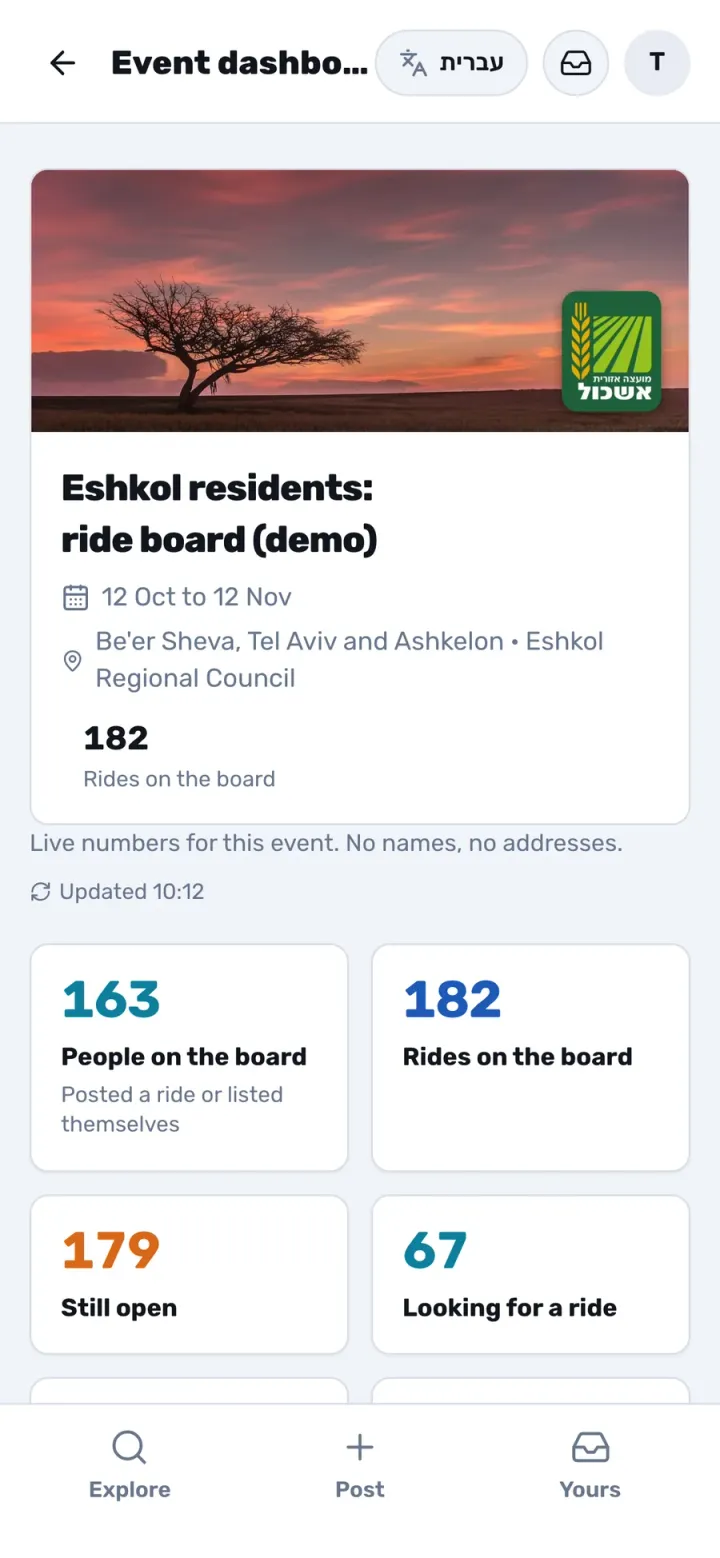
- You get numbers, not a spreadsheet. The organizer dashboard shows people going, rides to and from the event, people looking, invites, join requests, groups formed and people matched. It breaks rides and people looking down by departure area, and rides in each direction by day. It refreshes every minute and shows no names.
- No staff time. We build the page within 1 day, with a link, a QR code and print files for signs, answer users’ questions in Hebrew and English, watch the board before and on the day, and send a written report after.
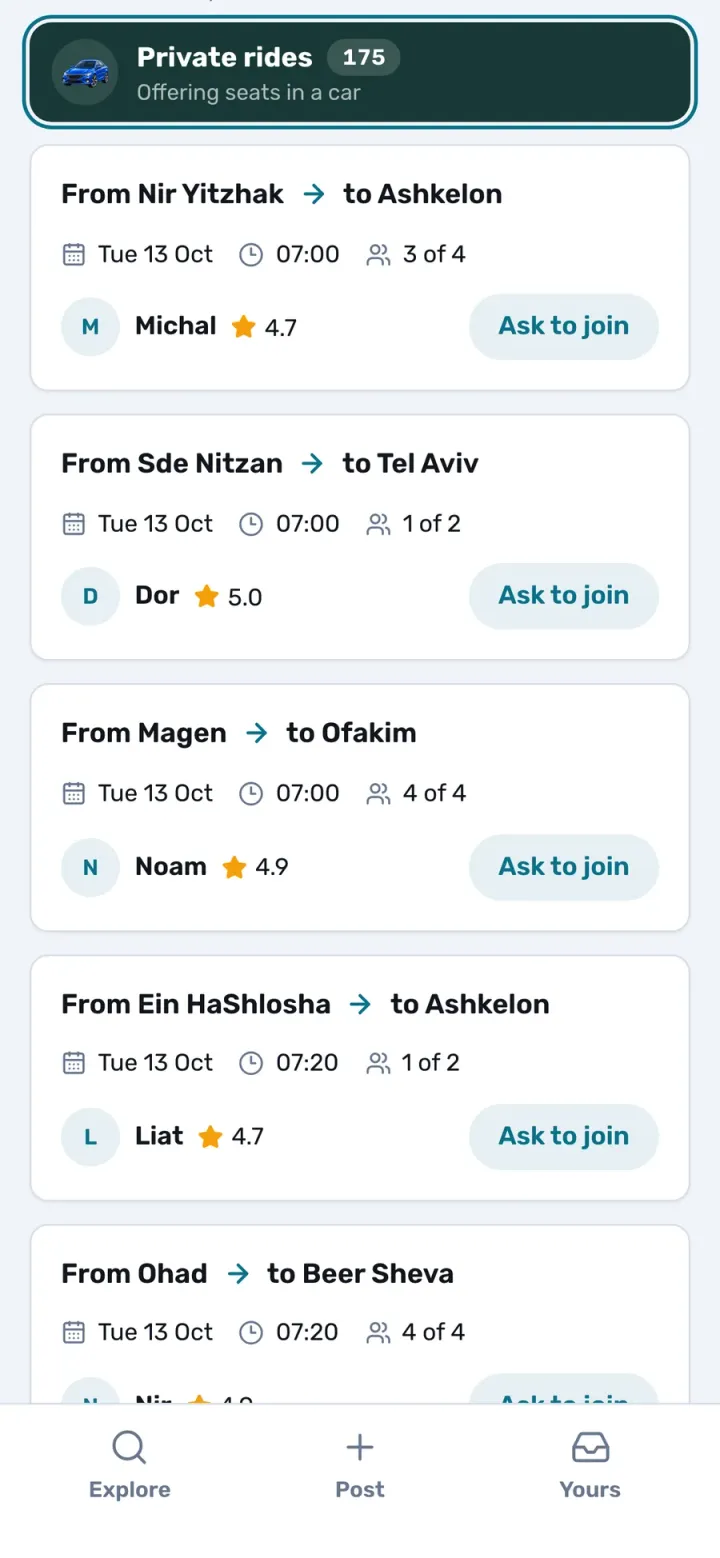
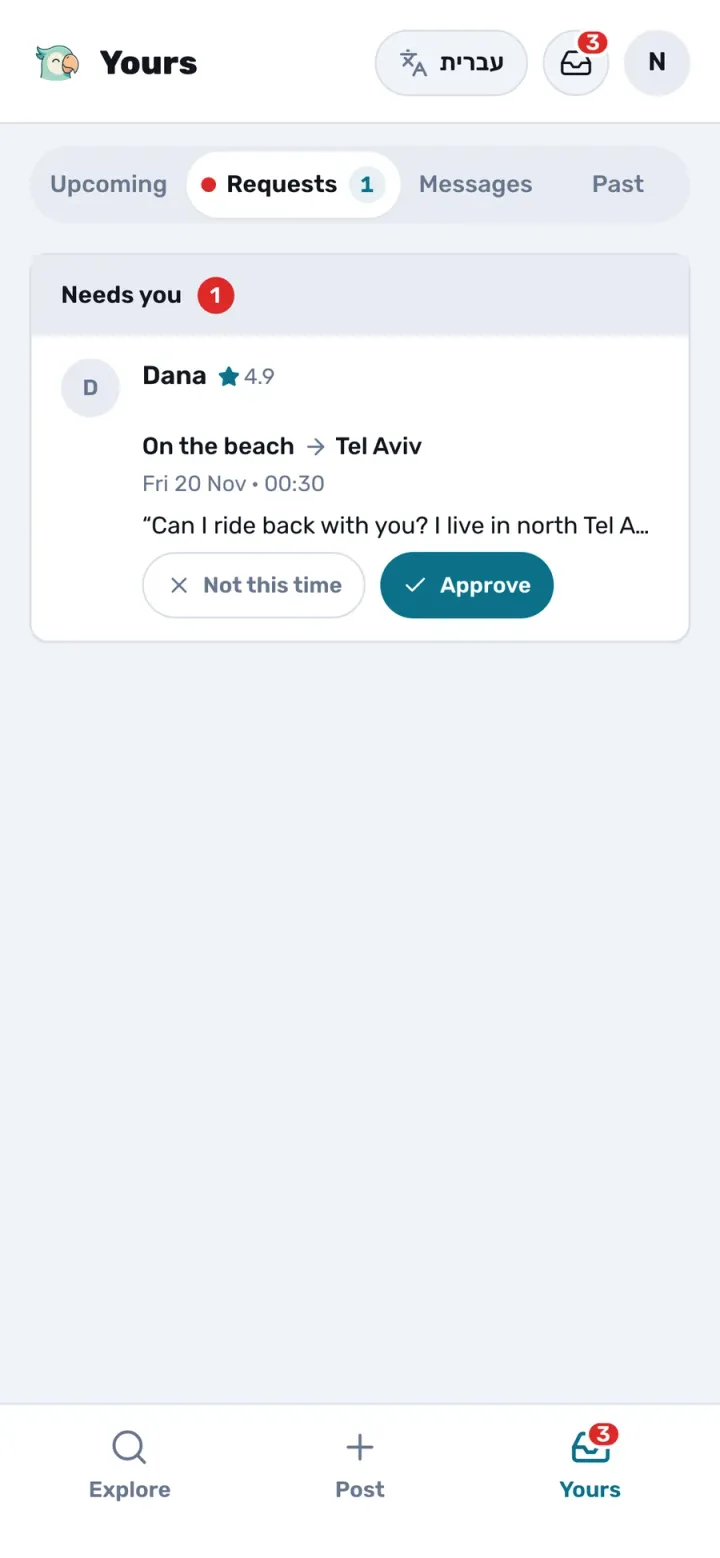
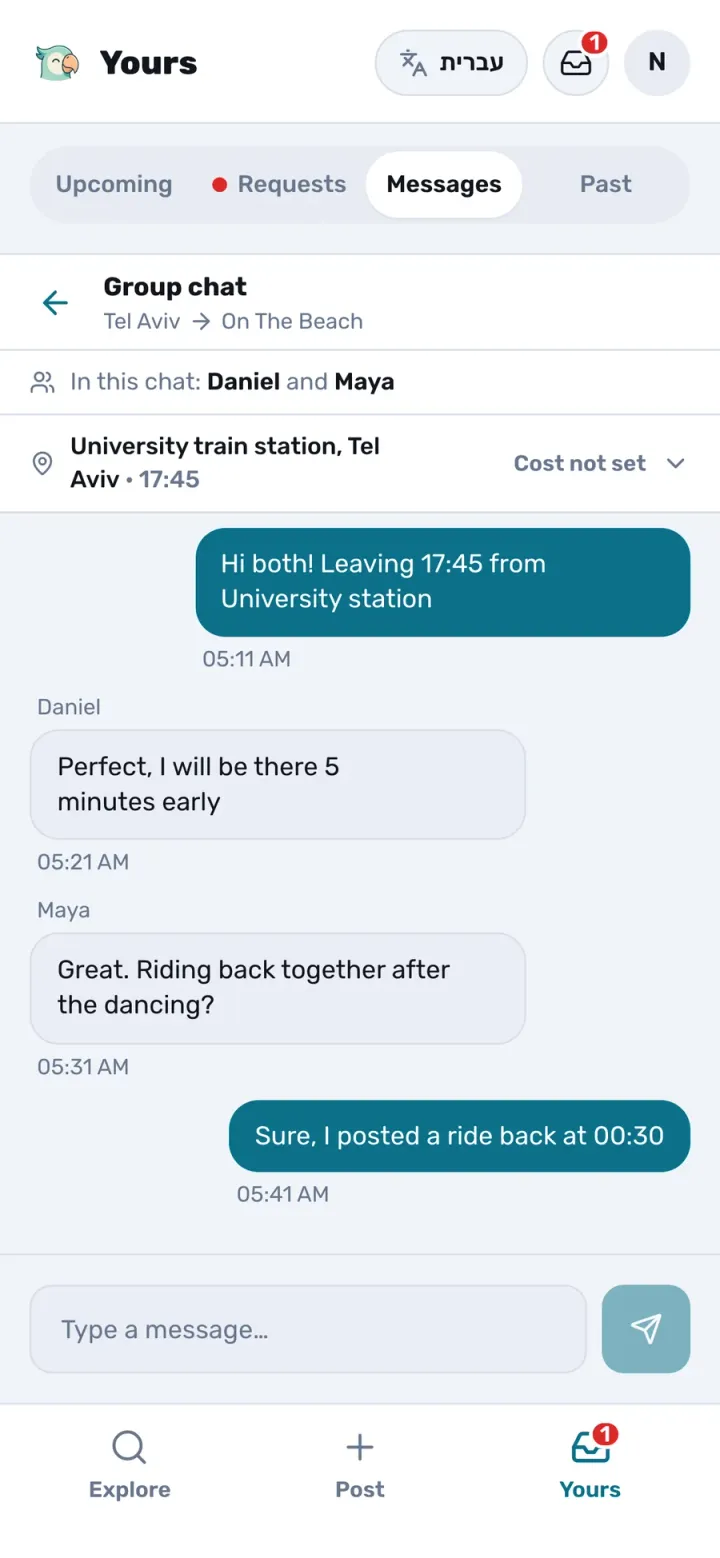
What it looked like at a real event, with the organizers sending only a banner and a link:

From a live event, October 2026
KAN Festival in the Judean Desert, with a PairMee ride board
The organizers sent a banner and their ticket link. We built the event page; they added a button to their website and a line to their FAQ. Nothing else was asked of them.
The full numbers and what we learned22
matches made through the board
Between 31 people: 18 without a car and 13 drivers
19
people in 9 cars, to the day of the ride
Kept their match until the day itself
68
people joined the board
Posted a ride or listed themselves as looking
619
people opened the link
350 of them straight from KAN's website
A match: a person without a car found a driver from their area, and the driver approved them. Figures from our production data, test accounts excluded.
It is not magic. A ride board does not create drivers, and it does not guarantee a match. It removes the work between “I have a free seat” and “you are in my car”, and it gives you the numbers afterwards.
When PairMee is not the answer
- Your group is small and everyone knows each other. Use WhatsApp.
- Nearly everyone leaves from the same place at the same time. Book a bus.
- You need payments, ticket integration or your own branded domain. We do not offer those.
For everything in between, see how it works for cities and councils, weddings, festivals and large events and companies, or split the cost of a ride with our split calculator.