

The short version
- Carpooling is legal, and so is sharing the cost, within limits set by a 2017 traffic regulation.
- The cost cap is ₪2 per km for the whole car, split equally among everyone in it, the driver included.
- Up to 4 passengers, arranged in advance, at most 2 rides a day. No picking up strangers along the way for money.
- No single carpool app is used by everyone. A carpool service run by a major navigation app closed in Israel in 2022, and nothing replaced it as one app for everyone.
- Uber style ride hailing is still not legal. The bill stalled when the Knesset went into election recess in July 2026.
The rest of this guide explains each rule with its source, works through the math, and describes honestly where people in Israel find shared rides today.
What the law allows
Israel regulates paid shared rides in private cars through an amendment to the Traffic Regulations, published on 11 December 2017 and in force 30 days later (Kovetz Takanot 7895, regulation 84B; consolidated text on Hebrew Wikisource). A ride in a private car for payment counts as a legal shared ride when all of these hold:
- Each passenger pays only their own share, and no more than their proportional part of the ride’s direct expenses.
- Direct expenses are capped at ₪2 per km of the ride.
- The share is equal for everyone in the car, the driver included. The driver carries a share like everyone else, so the driver cannot make a profit.
- At most 4 passengers, not counting the driver.
- Arranged in advance. The regulation says coordination by a computer application counts. Picking up people at the roadside for money does not.
- At most 2 such rides a day, both for the driver and for the car. In practice that is there and back.
A free lift is outside these rules altogether. The regulation only deals with rides where the driver receives payment or something else in return.
What a shared ride costs: a worked example
Take a 100 km ride. The cap for the whole car is 100 km × ₪2 = ₪200. Split equally among everyone in the car, it looks like this:
| Passengers | People in the car | Most each passenger pays | Most the driver collects |
|---|---|---|---|
| 1 | 2 | ₪100 | ₪100 |
| 2 | 3 | about ₪67 | about ₪133 |
| 3 | 4 | ₪50 | ₪150 |
| 4 | 5 | ₪40 | ₪160 |
3 things follow from the math:
- More people means each person pays less, and the driver never collects the full ₪200, because the driver’s own share stays with the driver.
- The cap is a ceiling, not a price. If fuel and wear for the trip come to less, agree on less. Many drivers ask for a round number below the cap.
- Agree before you leave. Settle the amount and how you will pay (cash or a payment app between you) when you arrange the ride, not at the destination.
If you are comparing with a taxi, remember that a taxi meter is per car, not per person. Our taxi fare calculator shows the legal 2026 meter for a route and what each person pays when 2 to 4 people share it.
Is there 1 carpool app everyone uses?
No. A carpool service run by a major navigation app matched commuters with drivers going the same way, and Israel was 1 of the few countries where it ran. It closed in 2022, and no single app has taken its place. Ride sharing in Israel now happens across several channels, described below.
The Uber law: where it stands
Carpooling and ride hailing are different things in Israeli law. A carpool shares costs and cannot make a profit. Ride hailing, where a private driver carries paying strangers for profit, is still reserved for licensed taxis.
A bill to open the market to online ride hailing platforms passed its first reading in the Knesset on 24 March 2026 (Channel 14, 24 Mar 2026). It went back to the Economic Affairs Committee and had not completed its second and third readings when the Knesset went into election recess on 17 July 2026, ahead of elections set for 27 October 2026 (TaxiHat, 19 Jul 2026). Whether it continues is up to the next Knesset. Our guide Is there Uber in Israel? covers what you can use instead and what taxis cost.
Carpool lanes and public transport lanes
Israel has 2 kinds of special lanes, and they are easy to confuse.
Nativ Plus, נתיב פלוס, and fast lanes. Lanes that favour cars carrying several people. The rules differ by road and changed in 2026: some lanes need 2 or more people, others 3 or more, and some became paid fast lanes. On the Coastal Highway (Route 2) and the Ayalon from the Netanya interchange south, the fast lanes charge a toll that changes with traffic, and cars with 3 or more occupants ride free (Globes, 9 Feb 2026). Check the sign at the lane entrance.
Natatz, נת״צ (public transport lanes). Most of these do not allow private cars even with a full car. Sign 501 sets who may use a lane and at what hours (Hebrew Wikipedia, public transport lanes in Israel). A carpool does not turn a private car into public transport.
Insurance
Private car insurance policies generally exclude carrying passengers for payment, which raised the question of whether a shared ride is covered. According to AIG Israel, it was clarified in 2017 that compulsory insurance (bitu’ach hova, which covers injuries to people) stays valid for a shared ride, for the driver and the passengers, including rides arranged through apps (AIG Israel, 29 Oct 2019).
That covers injuries. For damage to cars and property (comprehensive and third party policies) the terms are in your own policy. If you drive people regularly, ask your insurer in writing, and stay inside the regulation: a ride that makes the driver a profit is not a shared ride.
Where people find shared rides today
Sharing rides is an old habit in Israel: the word for a lift, tremp, is everyday Hebrew. Without 1 app that everyone uses, people use several channels, each good at something different.
WhatsApp and community groups
A lot of ride sharing in Israel happens in WhatsApp groups for a city, a route or a community. Some are very large: Jerusalem’s ride board group had over 45,000 members offering more than 300 rides a day as of December 2019 (Hebrew Wikipedia, shared ride). Groups are free and fast for people who already know each other. Their limits: offers scroll away within hours, every member sees every phone number, and there is no way to search by area or time.
Ride board services
Several ride board apps and websites organize the same thing more tidily: drivers post a route and a time, and people looking for a ride browse or search. Some run alongside WhatsApp groups. Whatever service you use, the regulation’s cap and conditions still apply to any payment.
Hitchhiking stops
Many junctions have a hitchhiking stop: a shelter where people wait for a free lift. It is a familiar part of Israeli life, especially for soldiers and people in smaller communities. It is spontaneous by design, which also means you do not know in advance who will stop.
Event and airport ride boards
For a specific place and time, such as a festival, a wedding, a city event or a flight landing at Ben Gurion, a ride board built for that event or route gathers the people going there in 1 place. That is the gap PairMee works on (see below). For the airport specifically, our guide to the Ben Gurion sherut covers the other options.
| PairMee | WhatsApp group | Hitchhiking stop | |
|---|---|---|---|
| Cost to use | Free for riders | Free | Free |
| Plan ahead | Yes, by area and time | Yes, if you catch the message | No |
| Who sees your phone number | Nobody, you talk in the app chat | Every member | The driver who stops |
| Who decides who rides | The driver approves each request | Whoever answers first | The driver |
| Best for | Events, the airport, intercity trips with strangers | People who know each other | Short hops, no planning |
Safety tips for shared rides
- Arrange it in writing first. Time, meeting point, route and amount. It is also what makes the ride legal when money changes hands.
- Meet in a public place. A station, a junction or a car park, not your home address.
- Share the details. Send the driver’s name, the car and the plate number to someone you trust before you get in.
- Keep your phone number private until you have a reason to share it.
- Choose who you ride with. Riders can ask for women-only rides on some platforms, and drivers can decline anyone.
- Trust your instinct. If something feels wrong at the meeting point, do not get in. No ride is worth it.
How we handle this in PairMee is on our safety page, and how women-only rides work is on /women.
Where PairMee fits
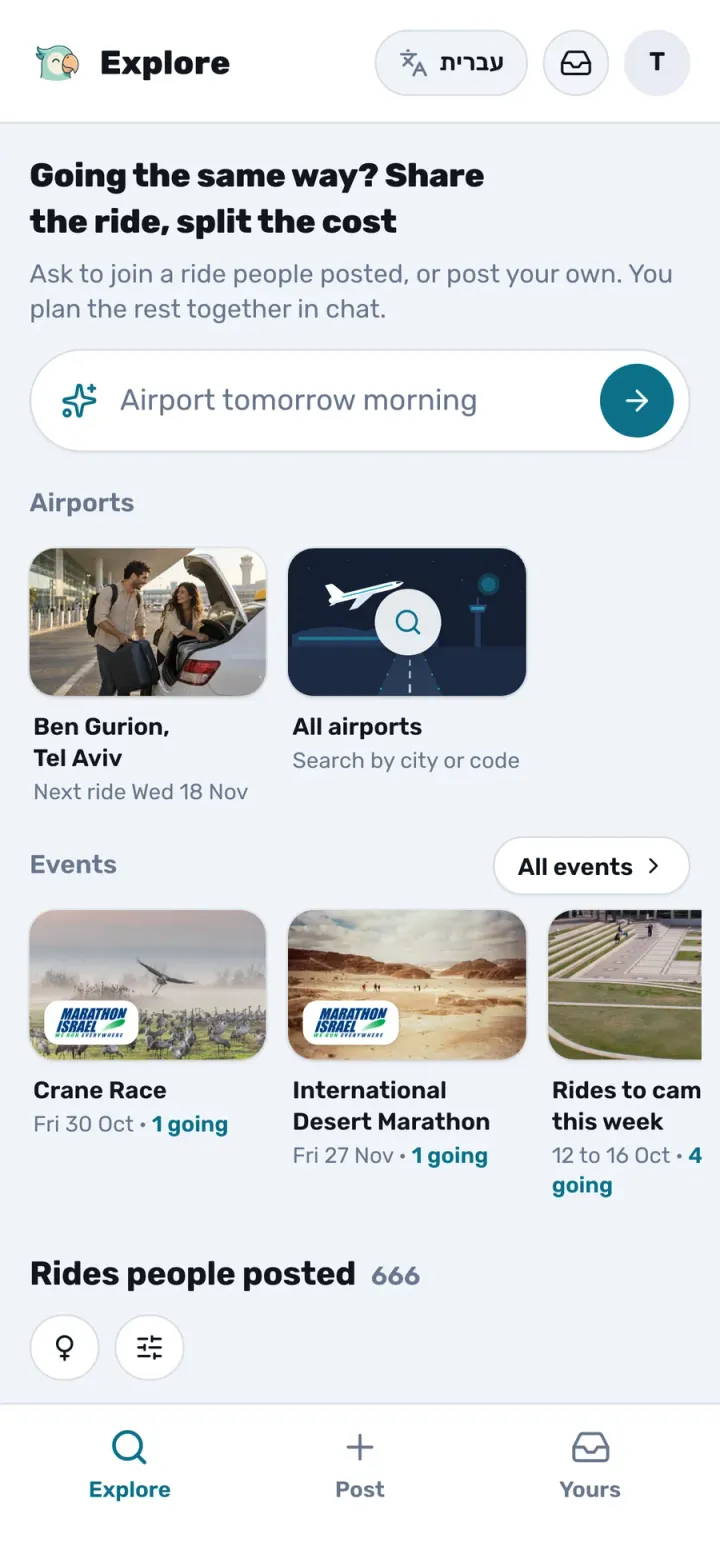
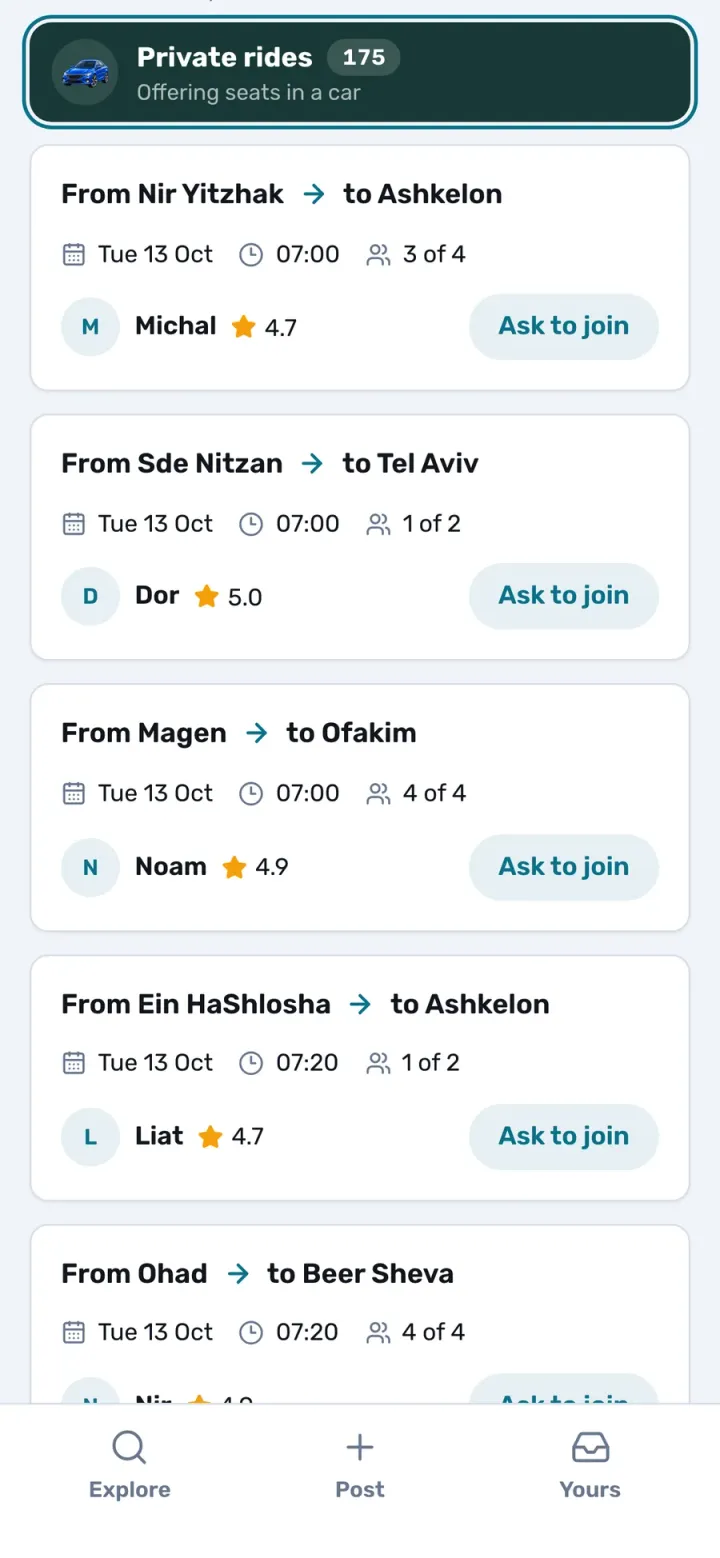
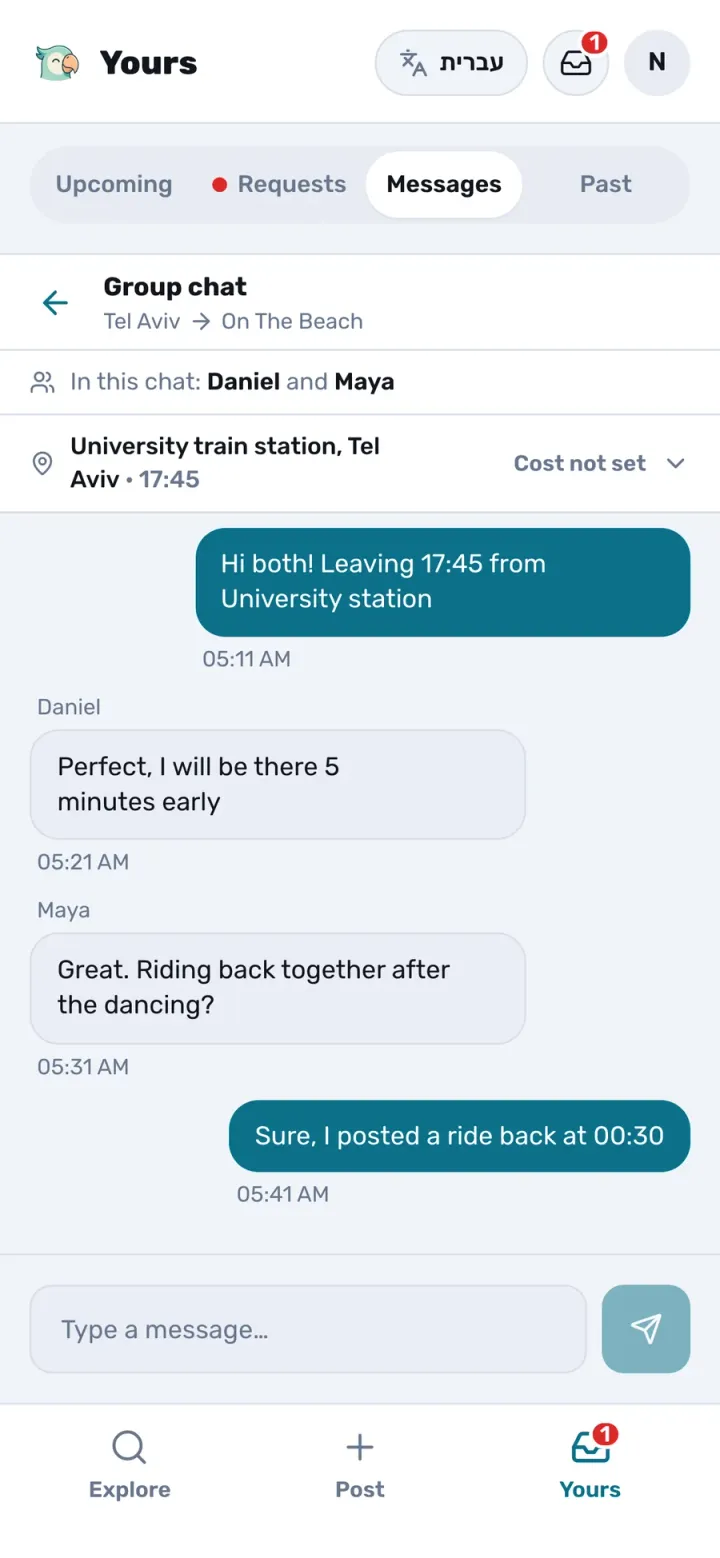
PairMee is not a taxi or a transport company. We do not supply cars or drivers. People who are already driving offer their free seats, people who need a ride ask to join, and the driver approves every request. Any cost sharing is settled between the people in the car, within the rules above. We take no cut and process no payments.
It works best where WhatsApp groups struggle: large groups of strangers going to the same place at roughly the same time.
- Events. Festivals, weddings, city events and conferences get their own page with lanes for rides there, rides back, people looking for a ride and taxi shares.
- The airport. People landing or flying out at similar times share the ride to and from Ben Gurion.
- Intercity trips. Anyone can post a ride or look for one between cities.
When it is not the right tool: if you already carpool with colleagues or neighbors you know, a WhatsApp group costs nothing and works. If you need 50 people moved at a fixed time, a bus is simpler. PairMee does not guarantee a match: a ride happens when a driver going your way posts it and approves you.
PairMee in 1 paragraph
PairMee is a free web app (app.pairmee.com) in Hebrew and English that helps people traveling the same way, at a similar time, find each other and share the ride. It launched in 2026, is run by its founder, Bar Ziv Neumann, and works across Israel, with a focus on events, Ben Gurion Airport and intercity trips. It supplies no vehicles or drivers: drivers approve each request, phone numbers stay hidden, pickup is shown as an area and never an exact address, and riders can choose women-only rides. It is free for riders, and event organizers can ask us to build a ride board for their event.
If you run an event and want a ride board for your guests, talk to our partnerships team on WhatsApp.